সোমবার, ০৯ নভেম্বর ২০২৬, ১২:১৩ পূর্বাহ্ন


1. Historical Background**
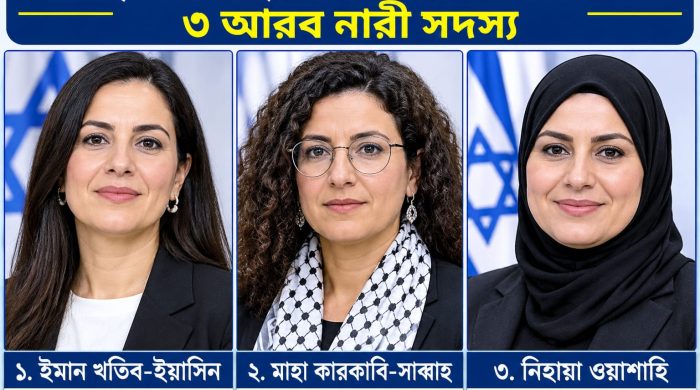
Following Israel’s general election held on 27 October 2026, three Arab Muslim women were elected to the country’s 26th Parliament, or the Knesset. They are Maha Karkabi-Sabbah, Nihaya Washahi and Iman Khatib-Yassin.
Their election to Israel’s 120-member Parliament marks a significant development in discussions surrounding the political representation of minority communities and women in the country. A total of 33 women have been elected to the new Parliament.
**2. Profiles of the Three Elected Women Members**
**a. Maha Karkabi-Sabbah**
She is an academic and sociologist. Associated with Ben-Gurion University, she has conducted research on Arab society, family, women and social inequality. She was elected as a candidate of the Joint List.
**b. Nihaya Washahi**
She is an elected female member representing the Joint List. Her parliamentary role could become significant in advancing the political representation and social development of the Arab community.
**c. Iman Khatib-Yassin**
She is a politician and social activist affiliated with the Ra’am party. In 2020, she made history by becoming the first hijab-wearing woman elected to Israel’s Parliament. Her academic background includes social work and women’s studies. Women’s rights, education and social welfare are among the key areas of her work.
**3. Political Significance of the Election**
In the 2026 election, the Joint List secured 11 seats, while Ra’am won 8. This means that the two Arab-led political alliances collectively secured 19 seats.
The outcome underscores the importance of Arab political representation in Israel. In particular, the participation of Muslim women in Parliament is not merely a matter of women’s empowerment; it is also an important dimension of the political participation of minority communities.
However, their election should not be interpreted as an indication that Israel’s state policies or its position on the Palestine-Israel conflict will undergo immediate changes. Their political positions, parliamentary activities and roles in policymaking need to be closely observed.
**4. Women’s Leadership and Democratic Representation**
The strength of democracy lies not merely in majority rule, but also in ensuring representation for minority communities, women and people from diverse political and social backgrounds.
The representation of Muslim women in Israel’s new Parliament has created an opportunity for renewed debate on women’s leadership, civil rights and inclusive democracy in Middle Eastern politics.
**Conclusion**
The election of Muslim women to Israel’s Parliament is a significant political development. However, its true significance will depend on how effectively they can contribute to advancing women’s rights, equal citizenship, the security of minority communities and the establishment of peace between Palestine and Israel.
Beyond political representation, the true measure of democratic success should be the establishment of justice, equal rights and human dignity.
*[The author, Professor M. A. Barnik, is a distinguished defence analyst and an astute observer of international geopolitical strategies.]*

সম্পাদক আল মাহদী; উপদেষ্টা সম্পাদক আল ফাতাহ হাবিবুল্লাহ
ঠিকানা : সাংবাদিক ভবন, বাসা নং ২২১/২২২ রোড়ঃ ৩৫ ব্লকঃ ট সেকশন নং- ৬ রূপনগর মিরপুর ঢাকা-১২১৬।