মঙ্গলবার, ১৩ অক্টোবর ২০২৬, ১০:৪৮ পূর্বাহ্ন

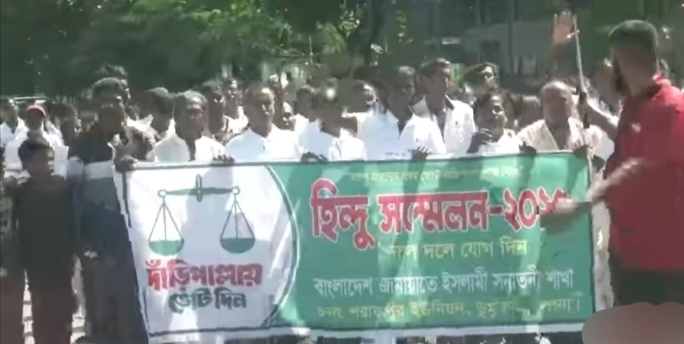

1. Jamaat-e-Islami’s Hindu Assembly:
The sun over Dumuria that day was of a strange color—
like a blood-mixed orange.
From the autumn air drifted the muffled rhythm of drums, and in front of the stage, red, blue, and green flags melted into the crowd’s uproar.
It seemed as though a new chapter of history was being written—
in the paddy fields, by the rivers, in the hearts of the people.

For the first time—
in Dumuria of Khulna, such a grand assembly was held in the name of the Hindu community,
where on stage stood Jamaat-e-Islami—
and in the audience, Hindu men, women, and youths applauded in the name of the “Scales.”
—
2. The Theatrical Setting of the Conference:
From morning, the upazila headquarters had turned into a festive fair.
Balloons, banners, and slogans filled the entire ground.
“We are no longer minorities—we are Bangladeshis!”
Every voice echoed this slogan.
Taking the stage, Jamaat-e-Islami’s Secretary General, Mia Golam Porwar, declared:
> “The Hindus can no longer be used. They are people of this land too, and their prosperity must be ensured.”
The words were political, yet carried a curious tone of humanity.
As if a new strategy—
where Islamic politics reached out to the language of social coexistence.
—
3. The Soil and Time of Dumuria:
In southern Khulna—
where the rivers change their course again and again, politics too shifts its color and voice.
There was a time when uttering the name Jamaat here was a perilous thing.
But now, that same party organizes a “Hindu Development Conference”—
a reverse-flowing current of politics,
where the boundaries of religion are being used as the language of unity.
Yet among the locals, another tone is heard.
An elderly Hindu farmer said:
> “Brother, no one ever called us like this before. But during election time, everyone suddenly shows affection.”
There was doubt in his eyes, yet a hidden hope in his voice—
perhaps for the first time, someone had recognized them as ‘Bangladeshi.’
—
4. The Deep Strategy of the Political Stage:
Behind this conference lies not merely religious harmony—
but a subtle political design.
Jamaat-e-Islami is now in a phase of reconstruction,
where the inclusion of “minority communities” has become a new tool of image rebranding.
The “Scales” is no longer just an election symbol—
it is being transformed into a story symbolizing justice and balance.
And this story now includes the participation of the Hindu community—something historically rare.
Political analysts note:
> “This is a new phenomenon in Bangladesh’s secular politics—
where an Islamist party itself is crossing religious boundaries to open doors into the minority vote bank.”
—
5. Far-Reaching Consequences:
This gathering is not merely a local political event—
its resonance is spreading across the national stage.
If this strategy succeeds,
it may mark the beginning of a new trend in Bangladesh’s politics—
a religion-based reconciliation politics.
Yet the risks are no less.
The revival of politics under the cloak of religion could again breed division,
if sincerity is absent—
if all these initiatives remain only within the arithmetic of votes.
History of politics reminds us—
> “The party that can earn people’s trust is the one that changes time itself.”
The Dumuria conference, therefore, stands as a political experiment at the turning point of time.
Its outcome will depend on—
whether people truly wish to see a “politics of unity,”
or once again become the “used” masses as before.
—
6. Conclusion:
At the end of the night, when the conference was over and the stage fell silent,
from afar, someone could be seen standing in the field, softly whispering—
> “We are all Bangladeshis.”
There was no politics in that voice,
only a faint gleam of civic consciousness.
And that light perhaps hinted—
that one day, this very field of Dumuria
may truly become the birthplace of a reborn Bangladeshi identity.

সম্পাদক আল মাহদী; উপদেষ্টা সম্পাদক আল ফাতাহ হাবিবুল্লাহ
ঠিকানা : সাংবাদিক ভবন, বাসা নং ২২১/২২২ রোড়ঃ ৩৫ ব্লকঃ ট সেকশন নং- ৬ রূপনগর মিরপুর ঢাকা-১২১৬।